
Technical and maintenance · Module 12
Fuel and lube oil consumption on ships
Fuel, lube oil and fresh water as a ledger, so the balance is derived rather than typed.
Bunker delivery note
What it is for
The requirement, and the problem
Fuel is the largest number on a supply vessel’s operating statement and the one most often recorded in a way that cannot be audited. A daily report that carries only a tank figure records the result of a measurement and loses the events that produced it.
This module keeps a ledger. There is an opening stock at a stated boundary, then receipts, transfers between tanks and consumption, and the balance follows from them. A sounding is entered as a reconciliation — with the difference visible — rather than as the truth that overwrites what the ledger said.
How it works
Three steps, on board and ashore
- 1
Record movements, not totals
Bunkering, transfers and consumption are each a movement in or out. Nobody types a stock figure.
- 2
Sound the tanks
A sounding is compared with what the ledger expects, and the difference is shown rather than absorbed.
- 3
Confirm the day
The day’s stock is confirmed once and carried into the daily report and the oil record book.
Example with demo data
What it looks like
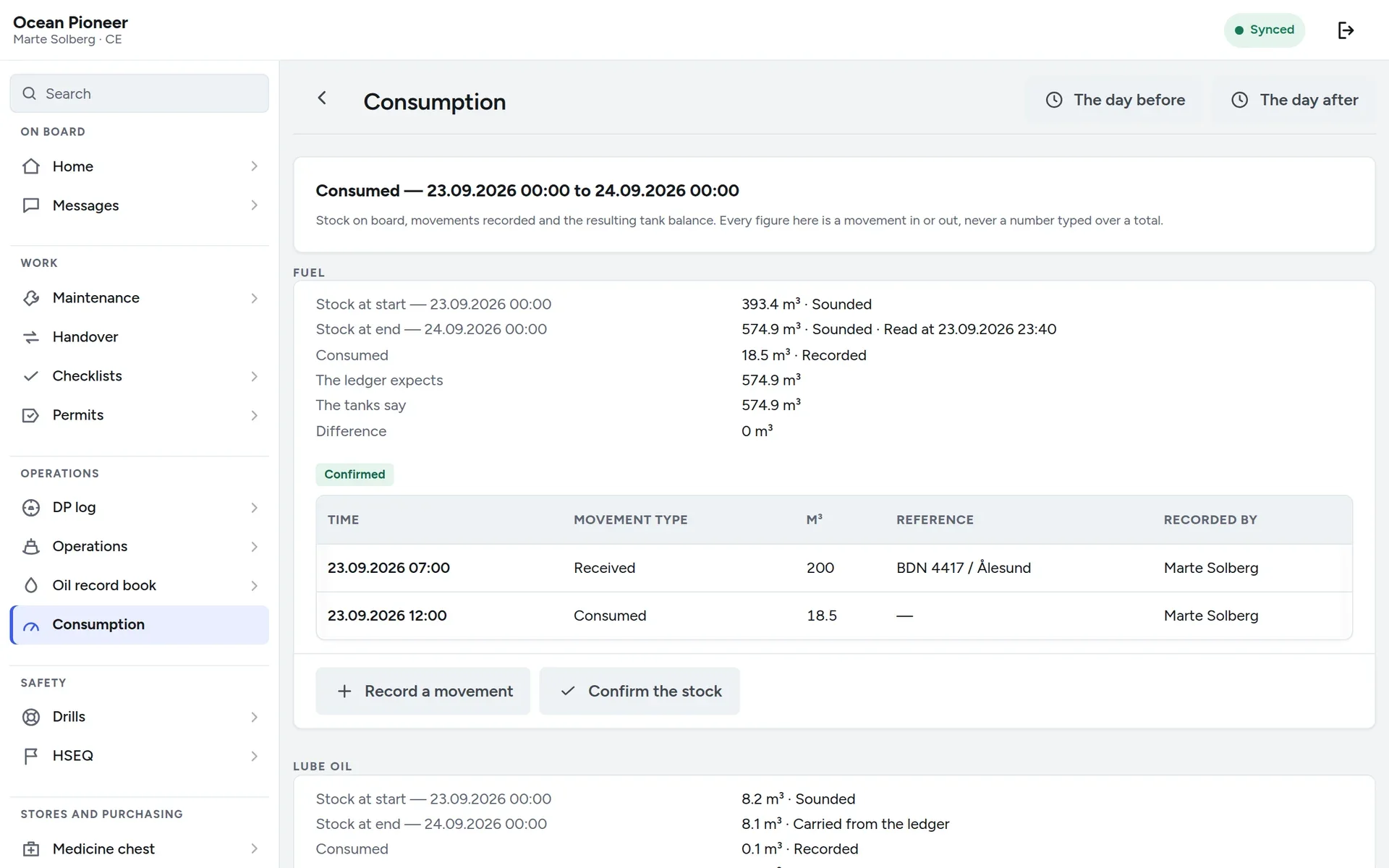
A working picture of the module with demo data from the Ocean Pioneer — the same ship you find in the demo.
Try the demo — no account, in your browser, with the PIN 1234.
- Consumption — the ledger, the balance and the reconciliation
- The figures as they appear on the daily report
In detail
What the module does
An opening stock at a stated boundary
Every ledger needs a beginning. The boundary stock is explicit, dated and attributable, so a figure a year later can be traced back to where the counting started.
Receipts, transfers and consumption as separate events
A bunkering is not a consumption correction. Keeping them apart is what makes a month’s figures explainable.
The balance is derived
Nobody types a balance. It is computed from the ledger, which means it cannot silently disagree with the events behind it.
Soundings as reconciliations
Enter what the tank actually measured and the difference from the ledger is shown. Over a voyage that difference is a measurement of how good the figures are.
Per grade, per tank
MGO and lube oils are different ledgers, and a transfer between tanks of the same grade moves stock without consuming it.
Feeds the daily report
The consumption figures on the daily report are the ledger’s, so the report to the charterer and the record on board cannot disagree.
The decision
A derived number cannot be argued with
When a charterer queries a month’s fuel, the conversation is either about events — this bunkering, that transfer, these sea days — or about whose tank gauge is right. The first conversation ends. The second does not.
That is the whole reason this module exists as a ledger rather than as two more fields on the daily report.
Works with
One product, not nineteen
Operations log and daily report
Port calls, activity, the daily report to charterer and owner, and the Garbage Record Book.
MARPOL Annex V, Reg. 10Oil Record Book
Part I as an electronic working copy beside the paper book: entries locked at signature, corrections as new entries, and a true copy that prints.
MARPOL Annex I, Reg. 17Purchasing
Requisition to receipt, on the shipowner’s own thresholds, where nobody approves their own commitment.
The shipowner’s own policy
Put one vessel on it for two months
No card and no implementation project. A company adds its own vessel and its own people on its own afternoon — and if it is not for you, you stop, with your data exported first.