
Modules · 11
Operations log and daily report
Port calls, activity, the daily report to charterer and owner, and the Garbage Record Book.
What it is for
The requirement
MARPOL Annex V Regulation 10 — from 1 May 2024, 100 GTEvery ship of 100 gross tonnage and above shall be provided with a Garbage Record Book. The threshold was lowered from 400 to 100 gross tonnage with effect from 1 May 2024, which brought a large part of the Norwegian coastal and offshore fleet into scope for the first time.
The daily report is the one document a vessel produces that somebody ashore is waiting for at a fixed time every day, and it is almost always assembled by hand from four other places — the bridge log for the position, the engine room for consumption, the deck for what was worked, the galley for how many are aboard.
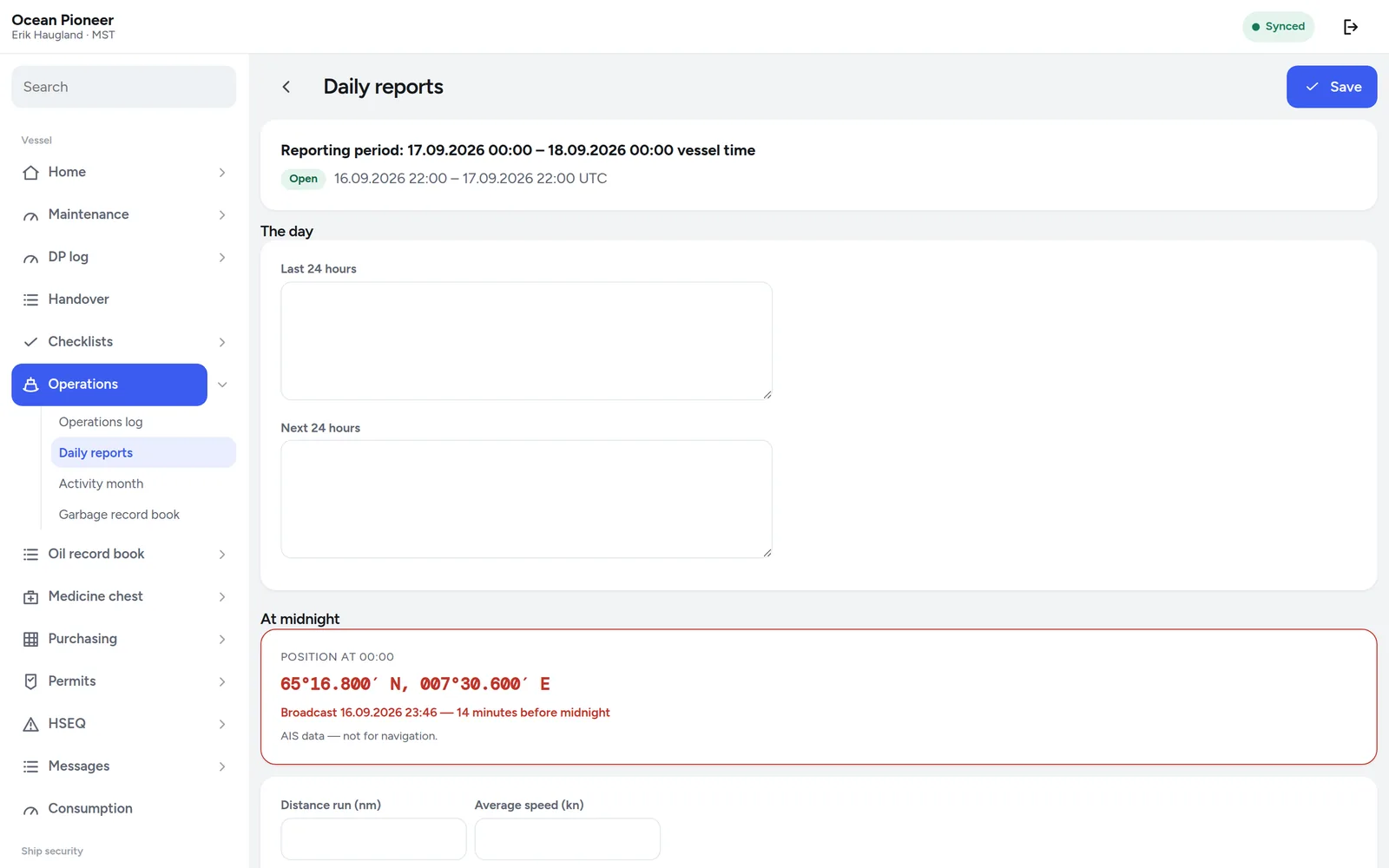
Here they are all one record already. The position comes from the vessel’s own AIS feed, the head count comes from the embarkation records, the activity comes from the log the bridge has been keeping all day, and the report is a view of them rather than a retyping.
In detail
What the module does
- The position, from the vessel’s own AIS. Decimal degrees stored, degrees and decimal minutes shown with a hemisphere, and — crucially — the age of the position. A position without its age is the dangerous kind.
- Heads on board, from the crew records. The daily report’s personnel figures come from who is actually signed on, split per employer, because a charterer’s report and an owner’s report count different people.
- Port calls with their purposes. Arrival, berth, purposes, departure — and the activity that happened between them, in the order it happened.
- The Garbage Record Book, at the new threshold. Discharges, incineration and landings recorded by category with the position, built to the five requirements IMO set out for an electronic record book.
- Known reception facilities remembered. The port you landed garbage at last time is offered next time. Small, and it is the difference between a book kept and a book reconstructed.
- The activity log, grouped by day and filterable by date. Years of it, dealt into years and months with the newest open, because a log that grows without limit needs a shape.
Screens
What it adds to the app
- Operations log — the day, in order
- Daily report — assembled, checked, sent
- Activity — the archive, by year and month
- Garbage Record Book — by category, with position
The decision
The position has an age
Every screen in this product that shows where a ship is also shows how old that information is, in four states: live, delayed, stale, or no recent position. A position shown without its age invites somebody to act on a four-hour-old fix as though it were now.
It cost a colour and a line of text per screen. It is the single cheapest safety decision in the product.