
Modules · 10
Oil Record Book
Part I kept electronically, with entries that cannot be altered after signature and a true copy that prints.
What it is for
The requirement
MARPOL Annex I Regulation 17 — FOR-1992-09-15-693Every oil tanker of 150 gross tonnage and above and every ship of 400 gross tonnage and above shall be provided with an Oil Record Book Part I (machinery space operations). Each completed operation shall be fully recorded without delay and each page signed by the master.
The Oil Record Book is the document that puts chief engineers in court. Not because they pollute — overwhelmingly they do not — but because a book with a gap in it, or an entry in the wrong hand, or a correction made with correction fluid, is treated as evidence of concealment whatever actually happened.
An electronic book removes most of those risks and introduces one: an electronic record that can be edited after the fact is worse than paper. So here an entry’s content is immutable from the moment it is signed. A mistake is corrected by a new entry that says what it corrects, which is exactly what the paper book requires and exactly what a database normally makes easy to avoid.
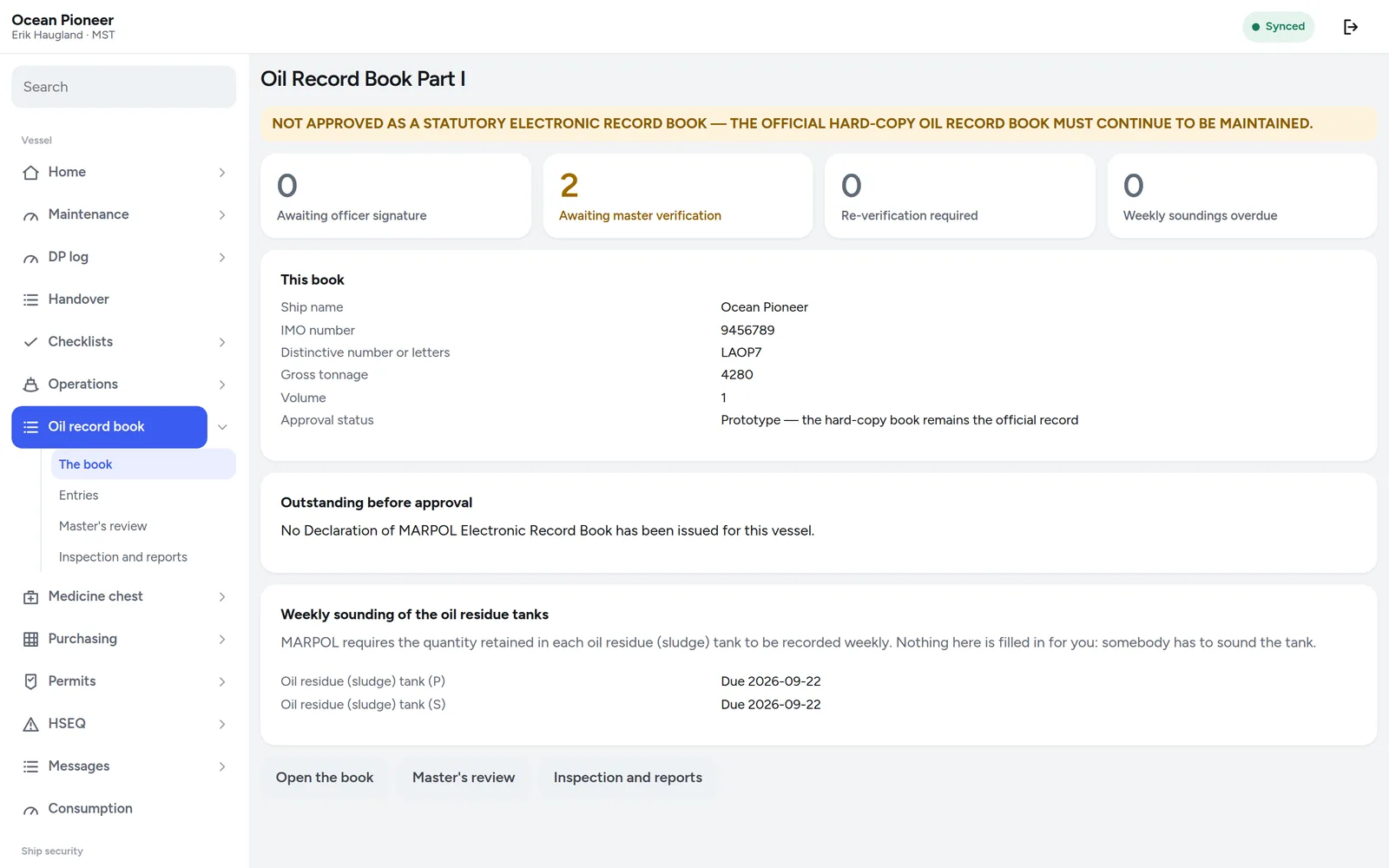
In detail
What the module does
- Coded entries, as the annex writes them. Codes A through I with the item numbers under each, prompting for exactly the fields that code requires and nothing else.
- Content-immutable after signature. Once an entry is signed its content cannot be changed. The product has no edit path, not a permission that is never granted — the difference matters when somebody asks how it is enforced.
- Corrections as entries. A correction is a new entry referring to the one it corrects, both visible, in order. That is the paper procedure, kept.
- The chief engineer’s review and the master’s signature. Entries are made by the officer in charge of the operation, reviewed, and the page is signed by the master, each step recorded with who and when.
- A true copy that prints. The print reproduces the statutory layout, with the entries, the signatures and a statement that it is a true copy of the electronic record — which is what a port state officer asks for.
- Inspection mode. One screen, one period, read-only, nothing else on the vessel reachable from it.
Screens
What it adds to the app
- The book — entries in order, as the book reads
- New entry — by code, prompting only what that code needs
- Review — the officer’s and the master’s
- Inspection — one period, read-only
- Configuration — tanks, capacities, and what this ship has
The decision
Approval is the flag state’s, not ours
An electronic record book needs the flag administration’s acceptance, and that is a conversation between a shipowner and its flag state. What we can do is make the record meet the requirements it will be judged against, and hand over the documentation of how it works.
The same applies to the Garbage Record Book in the operations module, which is built to the same five requirements IMO set out for electronic record books.