
Safety and the ISM system · Module 09
Defect and safety observation reporting
One button to report a defect or a safety observation, from any screen, by anybody on board.
ISM Code, clause 9
What it is for
The requirement, and the problem
Reporting culture is not created by a policy. It is created by whether a deck hand with oily hands, standing next to the thing that is wrong, can report it before he forgets — on the phone in his pocket, in under a minute, without a login he does not have and a form with a mandatory root cause field.
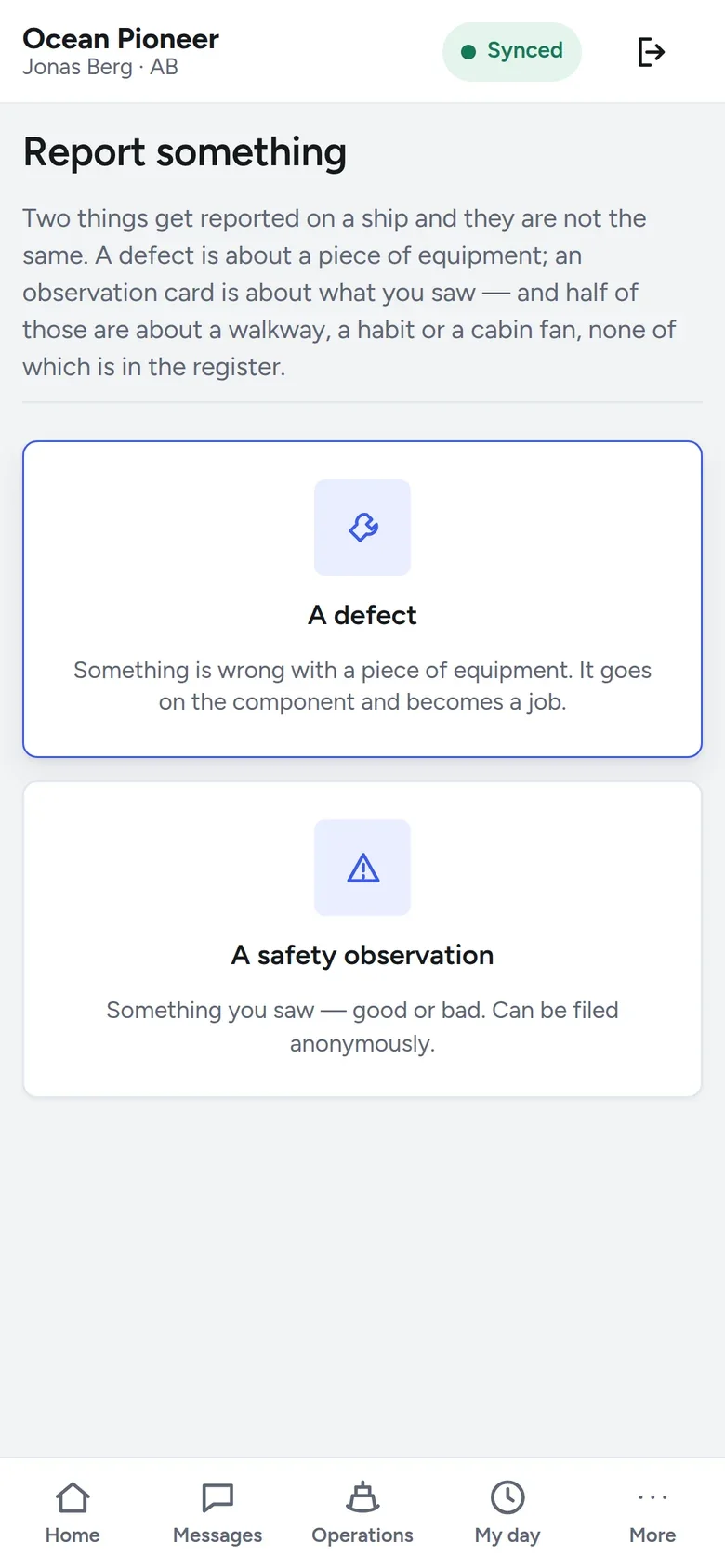
So this module is two cards and one button. A defect is something broken. An observation is something unsafe that has not broken yet. Both take a photo, a place and a sentence, and both go somewhere a person will read them.
How it works
Three steps, on board and ashore
- 1
Report from where it happened
A defect or a safety observation from a phone on deck, with a photograph — and an observation can be made anonymously.
- 2
It lands in the right place
A defect becomes a job on its component without anybody typing it again. An observation goes to the safety review.
- 3
Followed to closure
Actions are tracked until they are closed, and the record says who did what, and when.
Example with demo data
What it looks like
A working picture of the module with demo data from the Ocean Pioneer — the same ship you find in the demo.
Try the demo — no account, in your browser, with the PIN 1234.
- Report something — one button, two cards
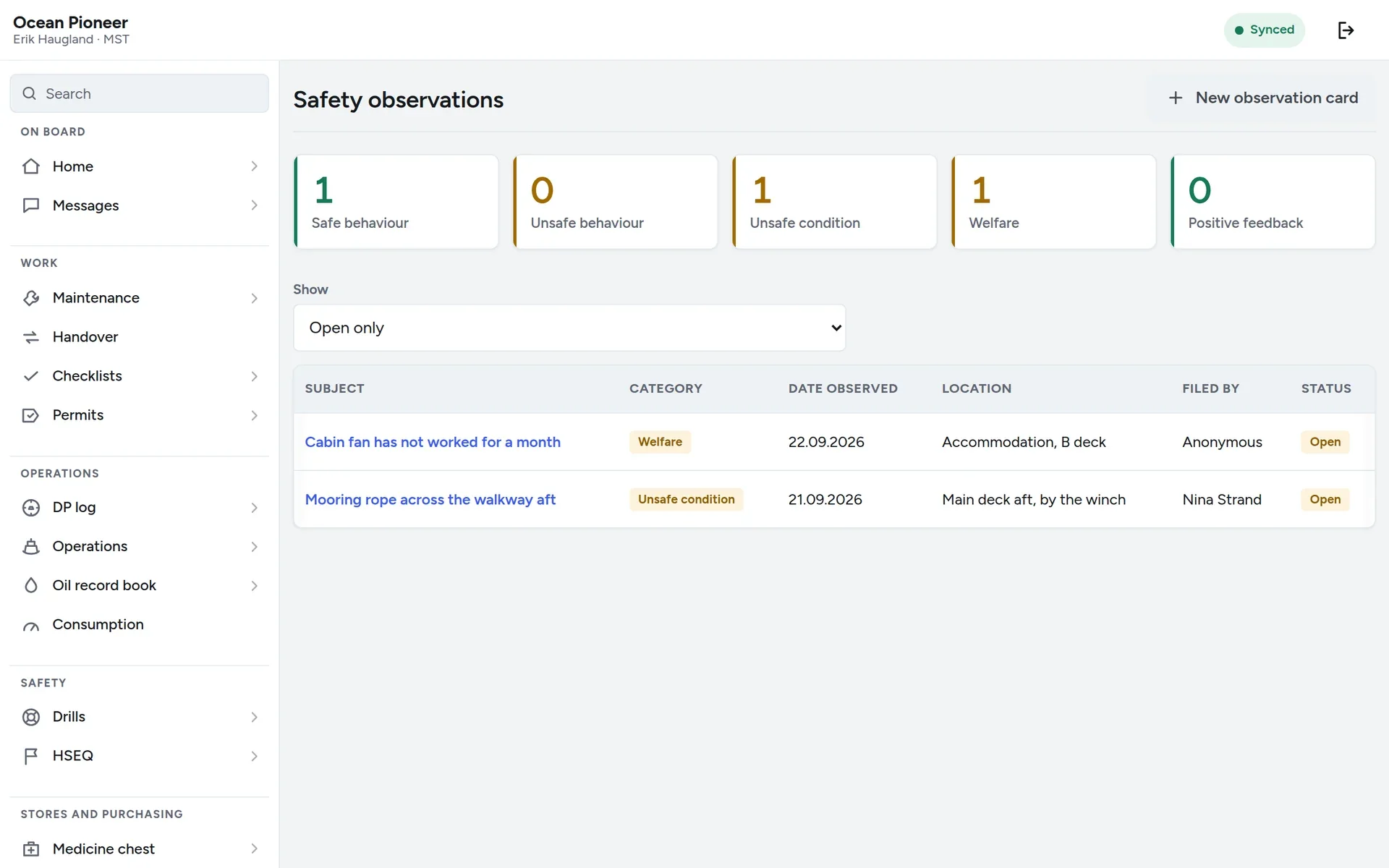
- Observations — the register, by year and month
- Reported
- Reviewed
- Action
- Closed
In detail
What the module does
Reportable by everybody
The permission to report is held by every role in the product, including the ones that can do almost nothing else. A system where only officers can report is a system that hears from officers.
A photo, reduced on the device
The image is scaled down before it leaves the phone, so a report goes out over a satellite link at a size that arrives.
A defect becomes maintenance, and keeps its origin
When a defect turns out to be work, it becomes a job on the component with the report still attached — so the history shows what was seen, not just what was done.
Observations are not a performance metric
There is no card count per department and no league table. Counting observations is how you get observations about tidy stores and none about the thing everybody is worried about.
A place from the vessel’s own register
The same locations the permits use. A report that says which space is the report that can be found again.
Visible to the office, without being taken off the vessel
The superintendent sees it as soon as the vessel has a link, and the vessel keeps the record whether the link comes back or not.
In the app
On the bridge, on deck and in the office
The same records on a phone in a machinery space and on a screen in the office — with no signal, and synchronised when the link returns.
- Defects — on the component they were reported on, each with the repair job it raised
The decision
Under a minute, or it does not happen
We timed it. A defect with a photo, a place and a sentence takes about forty seconds on a phone from a cold start, including the unlock. That number is the design constraint, and every field that was proposed for this form was measured against it and most of them lost.
The analysis fields — cause, category, corrective action — exist, and they are filled in afterwards by the person whose job that is. Asking the reporter for them is how you get no reports.
Works with
One product, not nineteen
Planned maintenance
Components, criticality and jobs that fall due on a running hour or a calendar, with postponement that has to be justified.
ISM Code, clause 10Checklists
The daily, weekly and monthly checks on board, with versioned wording and no duplicated occurrence when two devices are offline.
ISM Code, clause 7Permit to work
Hot work, height, enclosed space and general permits, with the isolations, the toolbox talk and the risk assessment attached to the job.
Offshore Norge 088Insights
Read more about this
Put one vessel on it for two months
No card and no implementation project. A company adds its own vessel and its own people on its own afternoon — and if it is not for you, you stop, with your data exported first.