
Modules · 05
Checklists
The daily, weekly and monthly checks on board, with versioned wording and no duplicated occurrence when two devices are offline.
What it is for
The requirement
ISM Code 7 — FOR-2014-09-05-1191The company shall establish procedures, plans and instructions for key shipboard operations concerning the safety of the personnel, ship and protection of the environment. A checklist is one of those instructions, and the version that was in force when it was signed is part of the record.
Checklists look like the easiest module in a ship management system and are the one most often got wrong, for two reasons. The first is that a signed checklist has to keep the wording it was signed under, or the record proves nothing. The second is that a checklist has a schedule, and a schedule written as rows in a database produces two copies of this week’s check the moment two devices are offline at once.
This module solves both structurally. Templates are versioned and a signed record points at the version in force at the time. Due-ness is computed from the schedule and the last completed record, and no occurrence row is ever written — so there is nothing for two devices to duplicate.
In detail
What the module does
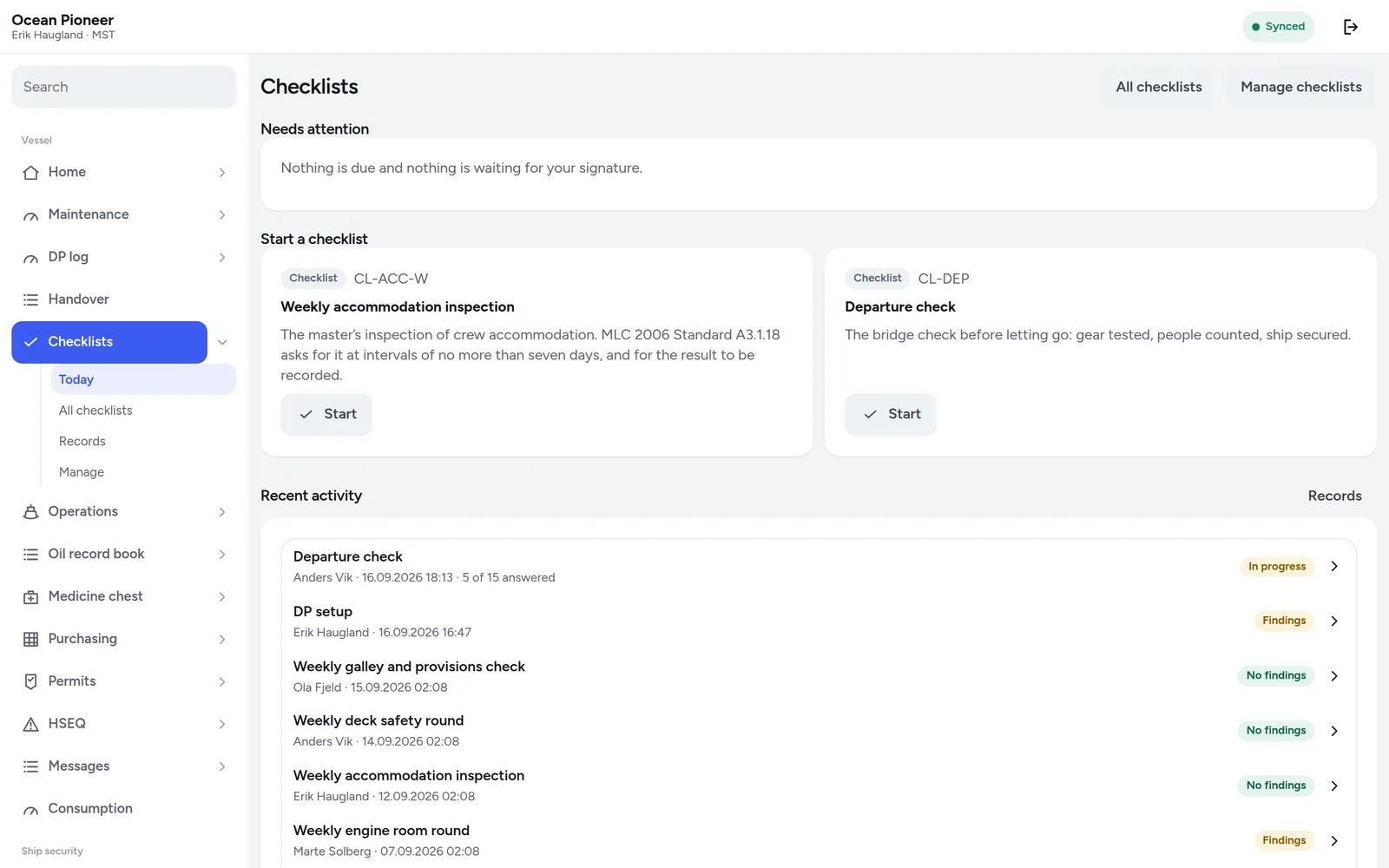
- One daily screen, three sections. Due today, overdue, and done today. A rating officer opens one screen and knows what the shift owes, without navigating a template library.
- Versioned wording, frozen at signature. Editing a checklist creates a new version. Records signed under the old one keep showing the old one. The template manager shows four derived states — draft, in review, in force, superseded — that come from the data rather than from a status field someone forgot to update.
- The author cannot approve their own version. The person who wrote a version is refused as its approver. It is the same separation the purchasing module applies to money, applied to procedure.
- Findings, and one word for no findings. A finding is read from the fields that were actually visible when the form was filled in — a hidden conditional question cannot produce a finding nobody saw. When there are none, the record says no findings, never pass, because pass is a grade and this is an observation.
- A vessel overlay that may only add. A vessel can add a question to a company checklist. It can never remove one. That is the only arrangement under which a fleet-wide procedure means anything.
- Eight checklists to start from. A new company begins with eight ordinary checks already written — and can rewrite every one of them.
Screens
What it adds to the app
- Today — due, overdue, done
- All checklists — the whole list with its schedule
- Records — the completed register, by year and month
- Templates — the builder and the approval queue, permission-gated
The decision
No second engine
Checklists, permits, toolbox talks, handovers, daily reports and job checklists are all the same thing: a versioned template, an instance, answers, and a signature. They run on one engine, so a rule fixed once is fixed everywhere and a form type added later does not arrive with its own bugs.
What the checklists module adds on top is small and specific: how a finding is read, how due-ness is computed, what the daily screen shows, and who may approve a version.