

Crew and welfare · Module 18
Cabins and berths on board
Decks, cabins and berths, who sleeps where, and the cleaning record — tied to the watch so nobody is woken.
MLC 2006, Regulation 3.1
What it is for
The requirement, and the problem
Cabin allocation is a five-minute job that becomes an hour when the information is in somebody’s head and that somebody has gone home. On a vessel running two rotations with hot bunking it is not a five-minute job at all.
The register here is decks, cabins and berths, and occupancy follows the crew list rather than being maintained beside it. The part that repays the effort is the cleaning board: it knows who is on the opposite watch, so a cabin is not cleaned at the hour its occupant is asleep in it.
How it works
Three steps, on board and ashore
- 1
Draw the accommodation once
Decks, cabins and berths, with cabins that can be taken out of service.
- 2
Who sleeps where
Berths are assigned to people, and the board shows at a glance what is free, occupied or waiting to be cleaned.
- 3
Cleaning on record
Each cleaning is recorded against the cabin, so the next person in knows it was done.
Example with demo data
What it looks like
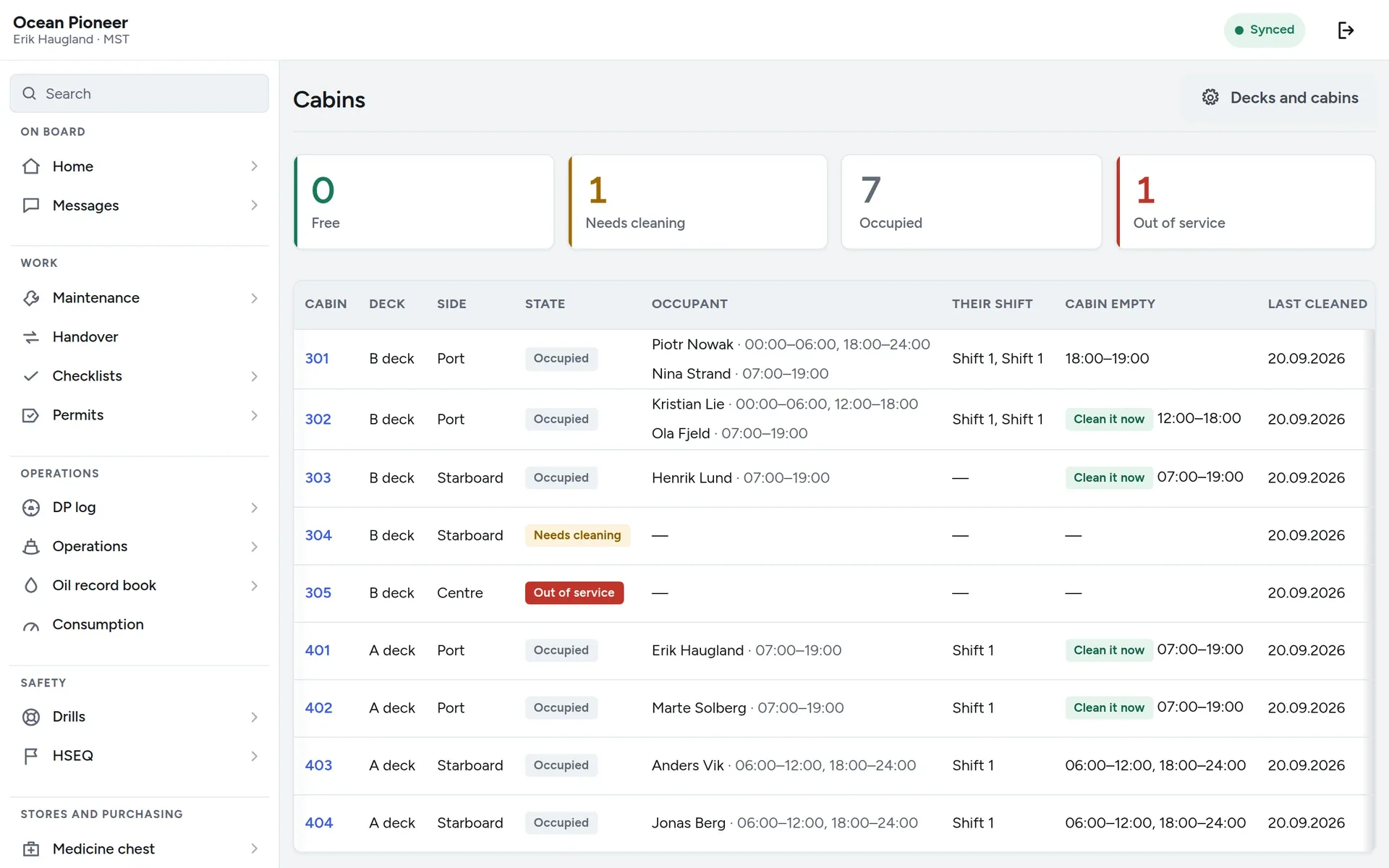
A working picture of the module with demo data from the Ocean Pioneer — the same ship you find in the demo.
Try the demo — no account, in your browser, with the PIN 1234.
- The cabin board — free, occupied, needs cleaning
- Layout — the arrangement as a plan
In detail
What the module does
Decks, cabins and berths as a register
The real layout of this vessel, once, and every screen reads it.
Occupancy follows the crew list
Sign a person on and their berth is allocated; sign them off and it frees. Nobody maintains a second list.
The cabin board
Free, occupied, needs cleaning — one screen the steward works from.
Tied to the watch
The board knows who is on which watch, so it does not propose cleaning a cabin whose occupant is in it.
The cleaning record
When it was done and by whom, which is the record MLC inspections ask for and the one nobody keeps.
A layout view
The arrangement as a plan rather than as a table, because a cabin number means nothing to somebody who joined yesterday.
The decision
Small modules are allowed to be small
Accommodation is two screens and it will stay two screens. A shipowner does not need a cabin management product; it needs to stop losing ten minutes a day and it needs the cleaning record to exist when MLC asks for it.
Resisting the urge to grow a small module is most of what keeps a system usable at the fifth year.
Works with
One product, not nineteen
Crew and certificates
Who is on board, what each position must hold, and which certificate expires before the crew change.
FOR-2011-12-22-1523Gangway and ship security
A tablet at the gangway that signs people on and off, logs visitors, and shows who is on board right now.
FOR-2004-06-22-972Work and rest hours
The daily record, the master’s review and the KS-0300 print, with every breach flagged as the rule that was broken.
FOR-2007-06-26-705 § 10
Put one vessel on it for two months
No card and no implementation project. A company adds its own vessel and its own people on its own afternoon — and if it is not for you, you stop, with your data exported first.