
Modules · 04
Work and rest hours
The daily record, the master’s review and the KS-0300 print, with every breach flagged as the rule that was broken.
What it is for
The requirement
FOR-2007-06-26-705 § 10 — føring av registreringsskjemaEvery seafarer shall have a form for recording their daily rest hours. The master, or the person the master authorises, shall check and record the rest hours in every period of 24 hours and of 7 days. The form shall be signed each month by the master and by the seafarer concerned, and the seafarer shall be given a copy. The limits themselves — 10 hours in 24, 77 in 7 days, at most two periods with one of at least 6 hours, and no more than 14 hours between them — come from STCW Code A-VIII/1 and MLC 2006 Standard A2.3.
Rest hours are the record a port state control officer asks for first, and the record most likely to be filled in on the morning of the inspection. That is not laziness — it is what happens when the form is a spreadsheet that nobody can reach from a cabin at the end of a watch.
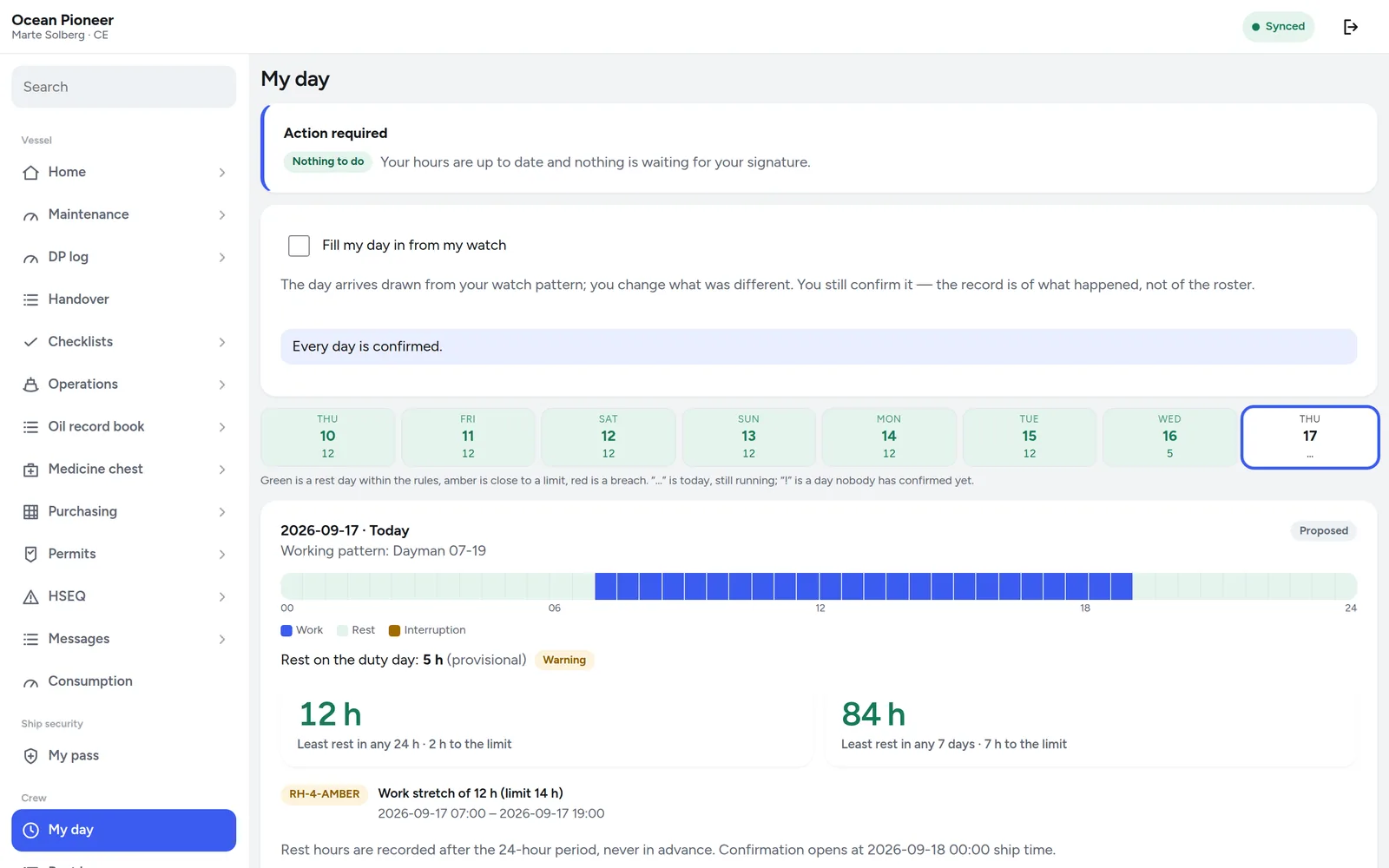
NoRemarks puts the day’s record on the person’s own screen, prefilled from the shift pattern they actually work, editable in the time zone the ship is actually keeping, and available with no signal at all. The four limits are checked as the record is entered, so a breach is discussed on the day it happened rather than discovered in March.
In detail
What the module does
- All four limits, each named when it breaks. 10 hours in 24, 77 hours in 7 days, no more than two rest periods with one of at least 6 hours, and no more than 14 hours between them. A breach says which rule and by how much, because "non-compliant" tells the master nothing he can act on.
- Prefilled from the shift pattern. Six on, six off is typed once as a pattern and proposed every day. The seafarer corrects the exception rather than drawing the whole day, which is the difference between a record kept daily and a record reconstructed monthly.
- The master reviews, and the review is a record. A review screen shows the week for every person with the breaches surfaced. The master’s acceptance is signed with a PIN and kept as an append-only version chain — a later correction does not erase what was signed.
- Ship time, and the day the ship is keeping. Records belong to the vessel’s time zone, including the days it changes. A clock change does not create a 25-hour day that quietly satisfies a 10-hour rule.
- Inspection mode. One screen to hand an inspector: a person, a period, the records and the exceptions, with nothing else on board reachable from it.
- The KS-0300 form, printed as the form. The statutory wording of the IMO/ILO record of hours of rest is reproduced, in the language the inspector is reading, and prints to paper that looks like what they expect.
Screens
What it adds to the app
- My day — the seafarer’s own record, one screen, works offline
- Master’s review — the week, per person, breaches first
- Records — the archive, by year and month
- Inspection mode — one person, one period, nothing else
The decision
A record you can defend, not a green tick
Some systems hide a breach behind a rounding rule so the month looks clean. That is the worst possible service to a shipowner: it converts a manageable conversation with a chief officer into a finding in a port state control report, with a record that says the company knew and did nothing.
Every breach here is visible, named and retained. The value of the module is that the master sees it the same week, while it can still be fixed by changing a watch rather than by explaining it to an inspector.