

Crew and welfare · Module 03
Crew list and certificates
Who is on board, what each position must hold, and which certificate expires before the crew change.
FOR-2011-12-22-1523
What it is for
The requirement, and the problem
The question a crewing officer actually has is not "which certificates expire this month". It is "which certificates expire while that person is at sea, on the rotation we have planned, in a position that requires them". Those are different lists, and only the second one prevents a sailing being stopped.
NoRemarks records the requirement on the position, not on the person: the company sets a baseline for a chief officer, a vessel may add to it — a DP certificate on a DP vessel — and may never take anything away. The effective requirement is what the screens read, and the horizon is computed against the planned rotation.
How it works
Three steps, on board and ashore
- 1
Sign people on
The master signs a person on with position, watch and the day they joined, and the crew list, the muster and the daily report follow.
- 2
Match certificates to positions
Each position carries the certificates it requires. What runs out before the next crew change is shown before it does.
- 3
Plan the relief
The office sees the rotation and a relief pool ranked by who holds what the position needs.
Example with demo data
What it looks like
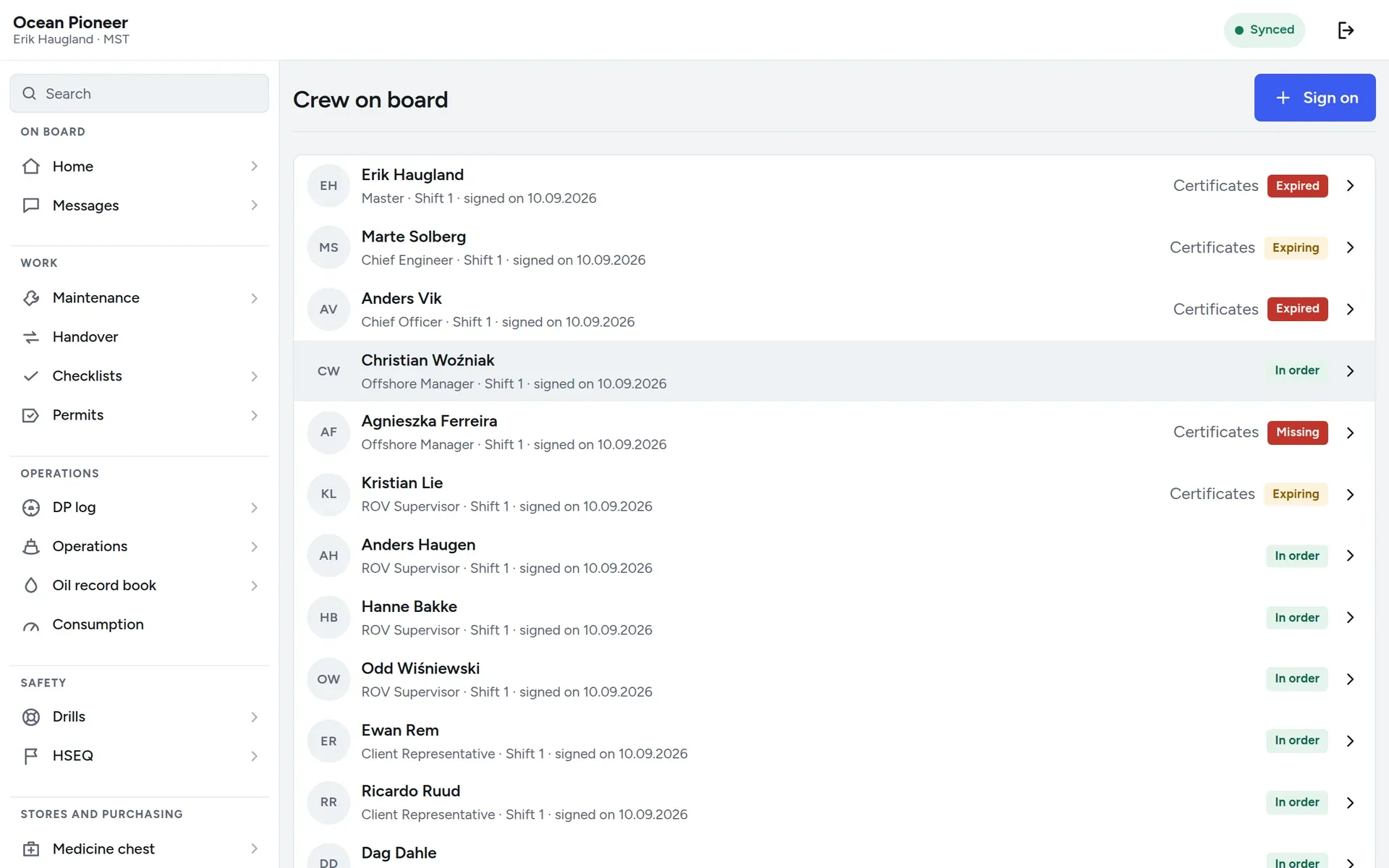
A working picture of the module with demo data from the Ocean Pioneer — the same ship you find in the demo.
Try the demo — no account, in your browser, with the PIN 1234.
- Crew list — who is on board, in which position, since when
- Certificates — per person, per position, with the document behind each
- Manning — coverage per shift against what the positions require
- Muster — present, missing, wrong station
Expiry measured against the next crew change, not against today.
In detail
What the module does
Sign-on and sign-off with both ends counted
A period on board has a start and an end, and sea service is computed from them with both ends counted the way a service record does it. A person who is still embarked has no end date, and the product knows the difference.
Requirement per position, overlaid per vessel
The company baseline says what a second engineer must hold. A vessel adds what its own operation requires. The overlay may only add — no vessel can quietly relieve a position of a statutory certificate.
An expiry horizon that knows the rotation
The office view ranks certificates by whether they expire during a planned trip, not by date alone. A certificate expiring on day 19 of a 28-day trip is the one that matters.
The muster, not a headcount
A muster shows who is here, who is missing, and who is standing at the wrong station. It reads the same embarkation records as the crew list, so a person cannot be mustered who was never signed on.
Manning against the safe manning document
The manning board compares who is embarked against what the positions require, per shift, so a gap is visible before the vessel sails rather than after.
Certificates filed with the document, not instead of it
An expiry date without the certificate behind it is a note. Each certificate carries the scanned document, its issuing authority and its number, and a superseded one is kept rather than overwritten.
The decision
A crew list is a safety document
The crew list is the first thing a rescue coordination centre asks for and the first thing that is out of date in most systems, because sign-off is a piece of office paperwork done on Monday for a Friday. Here the gangway signs a person off where the person actually leaves, and the crew list is right within the minute.
Personal data is kept to what a position and an emergency need. Everything sensitive lives in one place with its own access rule, and a person leaving the company can be erased without taking the ship’s statutory records with them.
Works with
One product, not nineteen
Work and rest hours
The daily record, the master’s review and the KS-0300 print, with every breach flagged as the rule that was broken.
FOR-2007-06-26-705 § 10The fleet office
Every vessel on one screen, the certificate matrix across the fleet, the rotation planner and the relief pool.
ISM Code, clause 12Accommodation
Decks, cabins and berths, who sleeps where, and the cleaning record — tied to the watch so nobody is woken.
MLC 2006, Regulation 3.1
Put one vessel on it for two months
No card and no implementation project. A company adds its own vessel and its own people on its own afternoon — and if it is not for you, you stop, with your data exported first.